


CRAB FARMINGEmpowerment in the tide, inequality beneath
by Marzia Prova
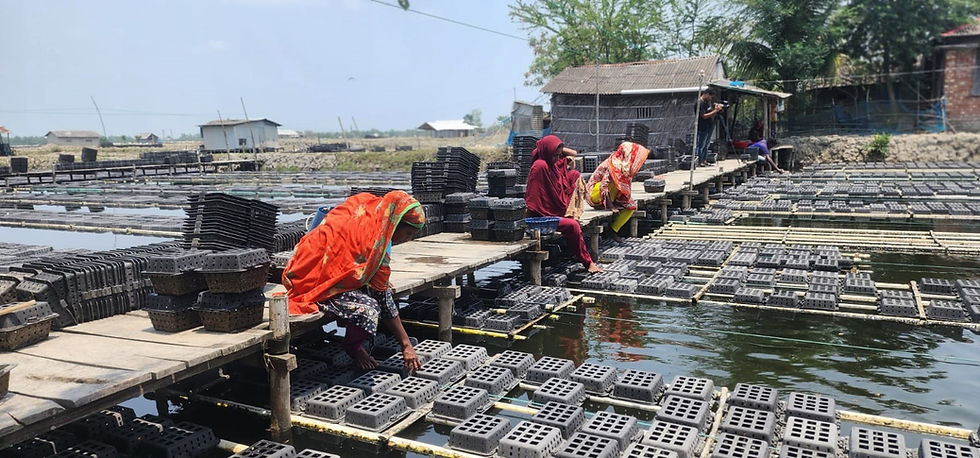
BY THE time I arrived at Porakatla village in Shyamnagar in the afternoon, the heat of the sun had begun to ease. Yet Shyamnagar in Satkhira District remains intensely hot because of the salinity in the water. On top of that, electricity is unavailable for nearly 14 to 17 hours within every 24-hour period. At the three fuel pumps, there were long queues of motorcycles and farmers waiting. Sitting in Dhaka, such a scene feels almost unimaginable. The purpose of my visit to Porakatla village was to speak with the local women crab workers and day labourers. Nearby, the wind from the embankment-less Kholpetua River was blowing steadily. I sat down. In front of me were ten women crab workers and day labourers, along with women engaged in earth-cutting work. Male labourers working at the crab collection point were also moving about here and there. All of the women were members of different projects run by the Christian Commission for Development in Bangladesh.
In the media and at various seminars, crab farming is widely presented as an empowering and promising avenue for women in the coastal regions. This perception is not entirely untrue either. In Satkhira District alone, around 30,000 coastal residents now depend on crab farming for their livelihoods (BBC Bangla, 23 July 2023). Among those involved in crab fattening work, 74 per cent are women, while nearly 20 per cent of those engaged in collecting crab fry are also women (Fish Innovation Lab, 2 February 2023).
As the women themselves said, there used to be very few opportunities to work outside the home. Now that they are able to do so, their households have seen some improvement in financial stability. Yet the cost of sustaining a family remains so high that they often fall back into cycles of debt. Still, if one looks through the language of development for “success stories” of women’s empowerment, those stories exist as well. Taking loans from NGOs, husbands and wives together are engaging in crab farming by setting up enclosures, and in some cases, they have even managed to repay those loans within a year.
But in viewing this expanding industry through the lens of empowerment, do the stories of inequality faced by women become obscured? If we set aside the language of empowerment for a moment, can we truly see how the women engaged in crab farming are living and working? That is what I sought to understand in the villages of Porakatla and Neeldumuria.
A woman named Hafsa (pseudonym) has been working as a checker in a crab processing factory for the past two years. The job of a checker is to monitor when crabs shed their shells. Once a crab moults, the discarded shell must be removed immediately and the newly emerged soft-bodied crab — known as a soft-shell crab — has to be quickly collected and frozen. If it is not frozen in time, the soft shell hardens within a short period, after which it can only be sold as a hard-shell crab by returning it to the water. The work requires intense concentration. The market for soft-shell crabs is not domestic; they are primarily exported to China. During the 2023–24 fiscal year, around 644.77 metric tonnes of soft-shell crab were exported, valued at approximately 8.02 million US dollars (Bangladesh Sangbad Sangstha, 2 July 2025). Crabs weighing between 1 and 61 grams sell for 350–400 taka per kilogram, those between 61 and 90 grams for around 800 taka, and crabs weighing 90 to 180 grams for as much as 1,300 taka per kilogram (Prothom Alo, 15 October 2025). To collect soft-shell crabs at the right moment, a checker must crouch down every two hours and inspect each crab box carefully to see whether moulting has occurred. This is the work Hafsa performs for 12 hours every day, with only a one-hour break. For this, she earns 8,000 taka a month. Yet a male colleague doing the same work for the same two-year period receives 10,000 taka.Why are male workers paid 2,000 taka more? Hafsa’s answer was simple: “The work is the same. We are paid less only because we are women.”
Sathi (pseudonym), meanwhile, explained that her job at the crab factory is that of a cleaner. The responsibilities include washing the boxes where the crabs are kept, cutting the crabs to help accelerate the moulting process, cutting fish for crab feed, placing the fish into the crab boxes, and maintaining the overall cleanliness of the factory. For all this work, Sumaiya earns 7,500 taka a month. The wages for cleaners are lower than those of checkers, even though the workload of a cleaner is far greater. When I asked whether a male cleaner would be paid more than her, Sathi replied, “The factory does not hire men as cleaners. All the cleaners are women. Men would not do cleaning work.” Since it was our first meeting, I could not immediately tell Sathi that it is not really a matter of men refusing to do cleaning work. Rather, factories assign cleaning jobs to women because women’s labour can be extracted more cheaply while demanding a heavier workload from them.
In the crab factories, while the wage structure for male workers ranges between 10,000 and 12,000 taka, women workers are paid between 7,000 and 9,000 taka. The same pattern of wage discrimination exists beyond factory work as well. From January to March, enclosures are prepared for crab farming, and day labourers are hired for earth-cutting work during this period. A woman labourer earns between 250 and 300 taka per day for cutting soil, while a man earns 400 taka for the same work. In the course of conversation, a young man from the village remarked that women are paid less for earth-cutting because, according to him, women cannot handle a spade properly and cannot cut as much soil as men.
But the women employed in earth-cutting work strongly disagreed with this claim. They said that many women are fully capable of using a spade and can work just as hard as men. Despite putting in the same level of labour, they are paid less simply because they are women.They also explained that when teams are formed for earth-cutting work, male workers often do not want women in their groups. As a result, women have to form separate teams and search for work on their own. Usually, only those who want excavation work done at lower cost are willing to hire them; others refuse to employ them altogether. At the same time, some older men are occasionally included in women’s teams, but they too are then treated as “weak” labourers and paid the same reduced wages as women.
This means that even within the same field of work, wages are differentiated according to notions of “strength” and “weakness.” Yet these ideas of strength and weakness are not determined by the actual amount or quality of labour performed. Rather, they are shaped by the employer’s own assumptions and by conventional social beliefs inherited from society. Otherwise, if wages were truly based on the nature and extent of the work, then a woman who is fully capable of cutting soil with a spade would surely be paid the same 400 taka as a man.
Workers in the newly emerging crab industry have no defined minimum wage based on economic standards. Men receive one wage rate, and women receive another. Moreover, wages are increased annually, but workers have no clear understanding of the rate or basis of these increases. They have no trade unions or any form of collective organization. According to Section 345 of the Bangladesh Labour Act, 2006 (amended in 2013 and 2018), equal wages must be paid to male and female workers for work of the same nature or equal value, and no gender-based discrimination is permitted. Similarly, the United Nations Convention on the Elimination of All Forms of Discrimination Against Women also upholds the principle of equal pay for equal work between women and men. It is evident that the state is neither enforcing its own laws nor complying with its commitments under the CEDAW convention in relation to wage practices in the crab industry.
The emergence of any new industrial sector is often associated with multiple forms of empowerment. Women’s economic empowerment, increased visibility of women’s work and mobility, and the enhancement of women’s self-respect in society are among the many indicators used to measure such empowerment. However, we often overlook a fundamental reality: it is labour that sustains an industry, not capital owners. The survival and growth of any industry depend primarily on the labour of workers. Therefore, if wages are not aligned with workers’ living standards and if safe and dignified working conditions are not ensured, such industries do not truly create empowerment. Instead, they often generate new forms of inequality. The rapidly expanding sector of crab farming, for instance, is primarily dependent on the labour of coastal workers, yet it is increasingly characterized by patterns of exploitation. Behind the large market and substantial foreign exchange earnings lies the often invisible reality of women’s labour being undervalued and underpaid. We must not allow these conditions of cheap labour to be obscured by narratives of growth and development.
Before leaving, with a slight hesitation, I ask crab worker Shibnarayan, “Do you accept the wage difference between men and women? Do you see equal pay for men and women as a form of competition?”I asked this with some hesitation, because as a feminist I am often told that demanding equal rights for women and men is seen as creating competition between the two. Shibnarayan, the crab worker, removes my doubt. He says, “What are you saying, sister! Why would there be competition? If my wife receives the same wage as me, that is a benefit for our family. More money will come into the household.”
Equal wages for women and men is not a matter of competition. It is a just demand as a matter of citizenship. Ensuring a national minimum wage of 25,000 taka in line with the cost of living is a realistic and reasonable demand. If the workers who keep the country running remain trapped in cycles of debt even after earning their monthly income, then neither the economy nor people’s quality of life can truly progress.
Marzia Prova is a writer and feminist activist. The author acknowledges the contributions of the Area Manager of the CCDB Shyamnagar Project, Sailen Folia, the Upazila Coordinator, Steve Roy Rupon, and Program Officer Neelima Rani, for their support in the preparation of this writing.


Comments