


INDEPENDENCE VS IDENTITY What Bangladesh is taking shape today?
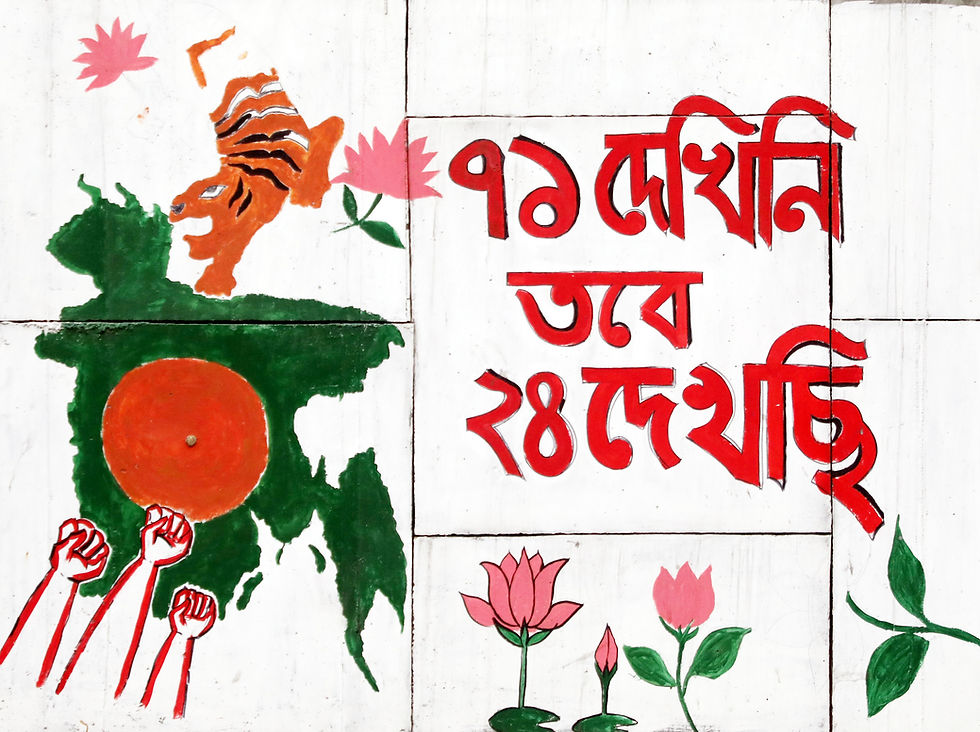
by Helal Mohiuddin
‘TELL me something,’ a friend asked over tea in Winnipeg, Canada, recently, stirring his cup like it contained the secrets of the republic, ‘are we still the same country that was born in 1971?’
I paused — not because I lacked an answer, but because there are too many possible answers. That, perhaps, is the heart of the problem. The ghost of 1971 still speaks, but in different languages. My friend wondered if the resurgence of Islamist politics in Bangladesh might disrupt and fracture the country’s secular identity.
I reminded him of something Amartya Sen wrote in his book, Identity and Violence: The Illusion of Destiny (2006): ‘The illusion of a singular identity is often the root of violence.’
I often return to this quote for a reason. In 1971, the vision was clear. In 2026, the situation is far from clear. The movement of 1971 aimed to build a secular, linguistic, anti-colonial nation-state — a rejection of religious nationalism and the notion that religion alone could define a nation. As Sheikh Mujibur Rahman famously declared, ‘The struggle this time is the struggle for our freedom; the struggle this time is the struggle for independence.’
Freedom means dignity. And dignity means plurality.
Political theorist Benedict Anderson warned us long ago: ‘Nations are imagined communities.’ Which means — they can be reimagined. And Bangladesh, today, is being reimagined. The founding vision — enshrined in the 1972 constitution — imagined a country that would rise above religion-based politics and instead build itself on secular identity.
I also quoted Sen to emphasise that history doesn’t repeat itself — it reappears in new forms. Sometimes as a warning, sometimes as a temptation.
Now, it is certainly high time to check whether history is taking rebirth, like a stubborn old relative refusing to stay put, or like a revolutionary, with open arms to embrace the brand-new realities of the present to pave the way for the future.
Over the decades, Bangladesh has oscillated between secular and religious nationalism — sometimes gracefully, sometimes with contention or violence. Religion-based politics, once banned, re-emerged during military regimes and has never fully left the stage. Now, after the seismic events of 2024–2026, it’s no longer on the margins but at the centre of the conversation. The question returns with urgency: Was 1971 about creating a secular Bengali nation — or simply escaping Pakistan? Those are not the same thing.
Let’s rewind to 2024, when the streets became the state. The streets rewrote the script of neo-noir independence. What began as student protests over job quotas quickly snowballed into something far more explosive. The state responded with force — killings, arrests and internet shutdowns — and suddenly, a generation that had grown up with smartphones and memes found itself writing history with blood and not with manifestos but with hashtags.
The result? A political earthquake. The long-standing government collapsed, and a new interim arrangement took shape. As Hannah Arendt observed, ‘Power springs up between men when they act together.’ That’s exactly what happened: power shifted, the regime fell, and with it came something unpredictable — a vacuum. As theorists from Hobbes to Foucault remind us, vacuums never last. Politics, like nature, abhors a vacuum. Where there is emptiness, force and ideology rush in.
In the aftermath, something remarkable — and unsettling to some, not many— happened. Islamist groups, long suppressed, re-entered the political field with renewed energy. Rallies swelled. Voices amplified. Narratives shifted. Alliances formed. Demands shifted from policy reform to deeper ideological restructuring. Some celebrated this as democratic inclusion. Others feared it as ideological regression. But here is where we must be careful. Political sociologist Olivier Roy’s assertion is worth remembering: ‘Islamism is not the return of tradition, but its transformation.’
In other words, this is not a simple ‘return to the past’. This is something new. A hybrid.
A mutation. A reconfiguration of religion within democracy. Whatever the case may be, the undeniable fact is that Bangladesh re-entered a new phase of contest between secularism and Islamic nationalism.
In a sense, these are global echoes: Bangladesh is not alone. Even secular societies are becoming less secular. Global history is full of examples of how religious or identity-based politics entered democracies — and later transformed the systems themselves. In France, debates over hijab, laïcité, and national identity dominate politics. In Germany, far-right parties frame immigration as a civilisational threat. In the US, abortion rights debates reveal deep religious divides. Perhaps this is why political philosopher Jürgen Habermas noted: ‘Post-secular societies must learn to live with the continuing vitality of religion.’ Before we panic — or celebrate — let’s zoom out. Bangladesh is also not unique.
In Turkey, secular Kemalist nationalism has been steadily reinterpreted through Islamic political identity. In India, a constitutionally secular state is increasingly shaped by religious majoritarianism. In Israel, debates rage between secular liberal democracy and religious-nationalist visions. Even in the United States, the so-called ‘culture wars’ often revolve around competing identities — religious, racial, and historical.
Far-right movements in Italy nowadays are mobilising around identity, religion, and ‘civilisational defence’. Political theorist Samuel P Huntington once argued: ‘The great divisions among humankind… will be cultural.’ He may have overstated it. But he was not entirely wrong. In fact, that is the world we live in. Religion is not disappearing. It is re-entering politics. And Bangladesh is part of that global pattern.
In the 2026 elections, for the first time in decades, Islamist parties gained unprecedented ground, even becoming the official opposition. Let that sink in. A country born from a war partly against religious nationalism is now witnessing its resurgence — not from the margins, but from within democratic politics.
Let’s be honest: the fear narrative was overused during the Sheikh Hasina regime. For years, a dominant story circulated — if Islamist politics rises, minorities will suffer, women’s rights will collapse, and democracy will die. The Hasina government skilfully promoted the belief that the rise of Islamist politics would mean intensified attacks on minorities, the erosion of women’s rights, and escalating conflicts over national identity.
This narrative was politically useful. But reality, so far, appears more complex. Islamist actors today are navigating elections, media, and public opinion. They are negotiating legitimacy. They are adapting. So far, the Islamist forces are faring quite well in making their political strides in Bangladesh’s newfound democracy, and people are not looking at this politics so negatively but rather approvingly.
The uncomfortable and unavoidable question that appears — ‘Is Bangladesh returning to a pre-1971 ideological terrain or evolving into something entirely new?’ In other words, it still raises a deeper question — are we witnessing radicalisation or normalisation? Because those are very different trajectories.
One of the most symbolic moments of this transition came not in parliament, but in the streets. After the 2024 upheaval, hundreds of statues, monuments, and symbols associated with the founding narrative were vandalised or destroyed.
You might say, ‘Well, statues fall in revolutions. That’s normal.’ True, but statues are never just stones — they’re arguments cast in bronze. When these are smashed, it signals that new ideas are emerging. The removal of Mujib-era iconography carries two meanings: a rejection of authoritarian legacy and a rejection of secular nationalism. Both interpretations coexist.
The destruction of Mujib-era iconography, for instance, was read by some as a rejection of the authoritarian legacy. But for others, it symbolised a deeper ideological shift — away from secular nationalism itself. In other words, this is not just political change. This is narrative change.
Here, the question of ‘identity’ jumps in. Identity is now a marketplace. Walk through Dhaka today, or scroll through Facebook — you will see three competing ‘versions’ of Bangladesh. First, the secular republic. Second, the hybrid compromise. Third, the future Islamic nation. Each comes with its own promise, fear and audience. The context echoes political scientist Ernest Gellner, who once wrote, ‘Nationalism is not the awakening of nations to self-consciousness: it invents nations where they do not exist.’
Bangladesh is witnessing this invention once more. Here’s the twist: the new generation isn’t choosing sides the way their elders did. Today’s youth are neither strictly secular nor Islamist. They’re religious, but not rigid; liberal, but not westernised; nationalist, yet globally connected. They turn politics into memes and remix ideologies. They’re not asking, ‘Secular or Islamic?’ but rather, ‘What works?’ And that changes everything.
I remember a viral joke on social media — ‘In Bangladesh, ideology changes faster than mobile data plans.’ I smiled but also recognised the truth. In fact, the real test is not ideology, but inclusion.
Let’s ground this. Because theory is easy, reality is hard. The real question is not which ideology wins but who gets excluded. Because history shows when identity hardens, minorities suffer. When identity polarises, democracy shrinks. When identity dominates, dissent disappears. Here I return to Sen’s warning: ‘The illusion of a singular identity is often the root of violence.’
Let’s return to the tea-table question — what is Bangladesh becoming at the end of the day? Is Bangladesh the same country? ‘Yes’ and ‘no’. ‘Yes’ because 1971 still defines its moral imagination. ‘No’ because that imagination is now contested. Bangladesh is not abandoning independence. It is renegotiating it.
Independence is not a mere memory. We often treat independence as a finished story. A past victory. A closed chapter. But maybe that is wrong. Independence is not an event but a process of continuous negotiation between power and people, identity and inclusion, and a mix of memory of the past and a vision for the future. And like all negotiations, it requires vigilance.
‘So,’ my friend asked again, ‘what are we negotiating?’
I smiled and said, ‘We are still deciding what to negotiate and what not!’
Dr Helal Mohiuddin is a social science educator-learner with special interest in sociology, anthropology, development planning, globalization, livelihood strategy, social safety-net and policy analysis.


Comments