


The nation is free, but what about its citizens?
by Ahmed Shamim
BANGLADESH is celebrating its 55th anniversary of independence as a nation, and it’s time to ask: Are the people of Bangladesh free and independent? There is no doubt that the people of Bangladesh are free as a nation. This identity stems from the international fact that Bangladesh has been an independent nation-state recognised by the world since 1971. However, whether the people are free and independent is a different question: does the state deliver freedom on various fronts to its people as promised? Bangladesh’s founding narrative promised to deliver what the Pakistani state had denied to East Bengal, later called East Pakistan.The political and economic deprivation and suppression of East Bengal set the course of the Bangladesh movement that came to fruition in 1971. Now, after five decades, what is the state of political and economic freedom for the people of the country?
It’s not a narrative but a fact that most of the time since independence, Bangladesh has suffered several authoritarian regimes. Some of those regimes are military, while others are electoral. A simple definition of an authoritarian regime is one in which the government and the state become indistinguishable, and the checks and balances among the different branches of government are dismantled, allowing the state to be ruled through fear rather than through the people’s mandate. The people experienced the quashing of democracy by leaders who had once fought for it during the inter-colonial Pakistani period, as well as the installation of military regimes they had earlier resisted. In addition, every democratic government that people elected eventually devolved into electoral autocracies or hybrid regimes. In other words, since independence, the people of Bangladesh have struggled to free their political life from the very authoritarian tendencies that they had sought to escape by breaking away from Pakistan.
It is deeply disappointing that the political climate of Bangladesh has largely continued that of the Pakistani period. Dissenting voices were strangled then and continue to be strangled now. At no point in the country’s political history have the people enjoyed a genuinely bipartisan parliament capable of establishing effective checks and balances on the government. From the outset, the constitution of the country has been skewed toward the executive branch. Moreover, the structure of the executive is tilted in ways that enable the head of government to accumulate tyrannical power. Bangladesh has witnessed military governments attempting—unsuccessfully—to transition into democratic rule, and democratic governments rapidly devolving into autocracy. Of course, many explanations can be offered for this recurring pattern—one might say that whoever goes to Lanka becomes Ravana, the tyrant. Yet one central cause stands out: the constitutional design of this so-called Lanka itself, which tends to transform any government into an autocracy and the head of government into a tyrant.
Modern experts in statecraft recognise that checks and balances within government are crucial for preventing the emergence of electoral autocracy. Such checks and balances are usually established among the three branches of government—the legislative, the judiciary, and the executive. However, in a democracy like Bangladesh, another relationship is equally crucial to monitor: the balance between the executive and the secretariat.
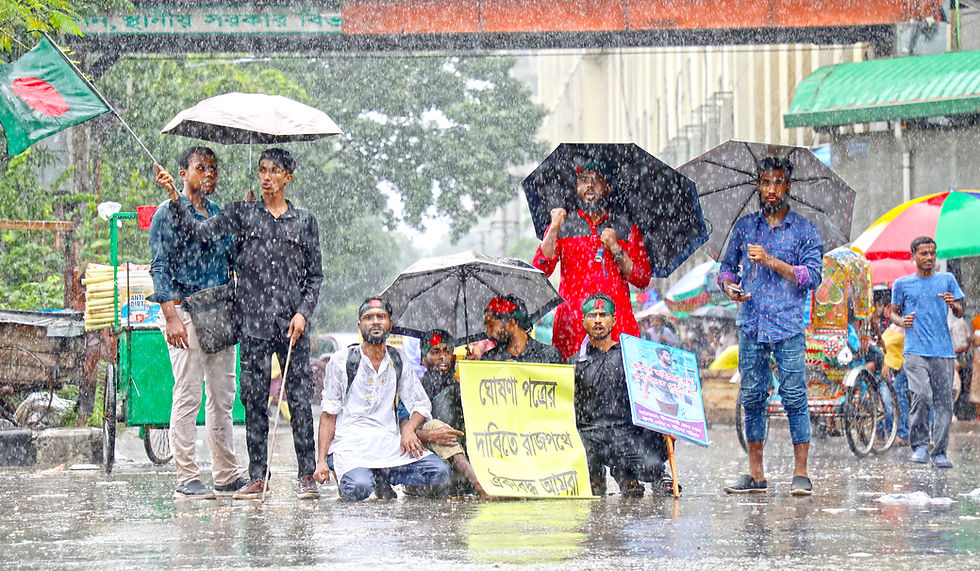
One might ask why this is so. In a democracy with relatively few informed voters, there is always the possibility that a cabinet will include members who are inexperienced or unqualified to lead ministries. For this reason, a professional secretariat—composed of secretaries selected on the basis of merit and experience rather than party affiliation—is essential. Since the 1990s, Bangladesh has experienced increasing politicisation of the civil service. Over the past two decades, politicised quotas within the recruitment pipeline have undermined the production of efficient and non-partisan civil servants. This system has not only consolidated party control over the government but has also generated a persistent political response among students. I would argue that students were bound to respond in this way—bound rather than free. The same can be said of the people more broadly: when citizens are not politically and economically free, they are bound to move toward mass uprising. This dynamic lies at the root of the mass movements of 1990 and 2024 in Bangladesh.
A government with checks and balances among its branches, and also between the ministries and their respective secretariats, delivers more freedom for the people. This freedom not only includes freedom of expression but also freedom from the street-bound life of political movements, protests, demonstrations, rallies, and the like. That’s the whole point of representative democracy: the representatives will bear the load, and the system will distribute the load appropriately to set the people free to live their social and personal lives.
They will have most of their waking hours to create value for society through their careers and creative endeavors. That’s one part of the story. The other part is economic freedom: solid employment and secure business opportunity— in other words, a steady source of income to gain freedom from poverty and to ensure upward movement in society for the upcoming generations. A people shackled in political and economic insecurities is far from being free. In a society where people are truly free, they can prosper without any favour from the political party in power. The opposite picture is the rise of the wealth gap in the country: a handful of people well connected to the political party in power getting super-rich, and the rest of the people getting poorer every year. That is, a system of special favour to the people who will, in turn, reward the political elite in the government cannot alleviate poverty. It needs a general setup favourable for ordinary people to prosper. The aforesaid checks and balances are part of that general setup, and so is the decentralisation of government.
The difference between a nation being free and the people being free needs to be realised to better understand the attitude of the people toward the state. Free people see their relation to the state as less mediated by the whim of the government(s). The people are more used to seeing the governments, not the state, because all the governments usurped the state and did not leave a healthy space between the government and the state in relation to the people. For instance, every government has changed the operations of the state in such a way that there is no continuity of the fundamental programmes of the state for its people. In a true democratic state, the fundamental deliverables are institutionalised so that a change of government does not affect them. Moreover, the people could not take the government to the Supreme Court for its wrongdoing, fearing retaliation from the party cadres or the government itself. The people could not change their representatives when the latter failed to deliver because the elections were not free and fair. The last mass movement that spiralled out of a student movement was an attempt to dig up the state by removing the government. Hence, the movement later turned out to be a movement for constitutional reform.
There is no way out of this destiny of recurrent despotism, which is caused by the algorithm systematically enshrined in the constitution and the codes of different institutions like public administration, police, secretariat, and the like, other than a targeted reform of the constitution and the codes. The interim government, with its record of failure on governance, was nevertheless successful in collecting recommendations for reforms through some reform commissions. We can argue for eternity about the method the past government used to get the mandate of the people for those recommendations, but there is no doubt that there are many recommendations there that will set the course for the freedom of the people from fear of electoral despotism if implemented. Now the question remains: why would the current government go on a spree of constitutional reform that will decentralise its power? Well, first, the party now in power, namely the Bangladesh Nationalist Party, had the opportunity to observe from the first row the devolution of an elected government into a despotic regime—the authoritarian regime of the Awami League. While the BNP suffered under the Awami regime, they proposed a set of reforms. So, we can say with some confidence that the BNP understands the need for constitutional reform. Now, the two-thirds victory could turn into a curse in disguise for the current government if they do not participate in the reform process. They can sink into the quicksand of constitution-crafted authoritarianism even with other efforts to stay on the course of democracy.
If the current Bangladesh Nationalist Party-led government delays the reform, it will soon be tagged as an anti-reform party, even though, as a party, they were the ones who first proposed constitutional reform. The current opposition will harvest the title of the proponent of constitutional reform, although the larger flank of the opposition has never floated any layout of constitutional reform in public, and the smaller flank is known for the second wave of the quota reform for the civil service. That is not the only loss the BNP will incur. Any failure to deliver good governance on the part of the BNP will be marked as the result of the anti-reform stance of the party, no matter what the sources of the failure are. The government should realise that it will soon lose this two-thirds majority unless it does these two things without delay: present to the public which recommendations it has disagreed with, its note of dissent and why; and which recommendations it has agreed to implement and when it will start implementing them. In short, the Bangladesh Nationalist Party should present a clear roadmap for constitutional reform to the public and start acting on it as soon as possible; otherwise, it should prepare itself either to keep power by force or to sit in the opposition in the next election.
Dr Ahmed Shamim is the Academic Programs Coordinator at Cornell University’s Language Resource Center.


Comments